Know tomorrow’s position today.
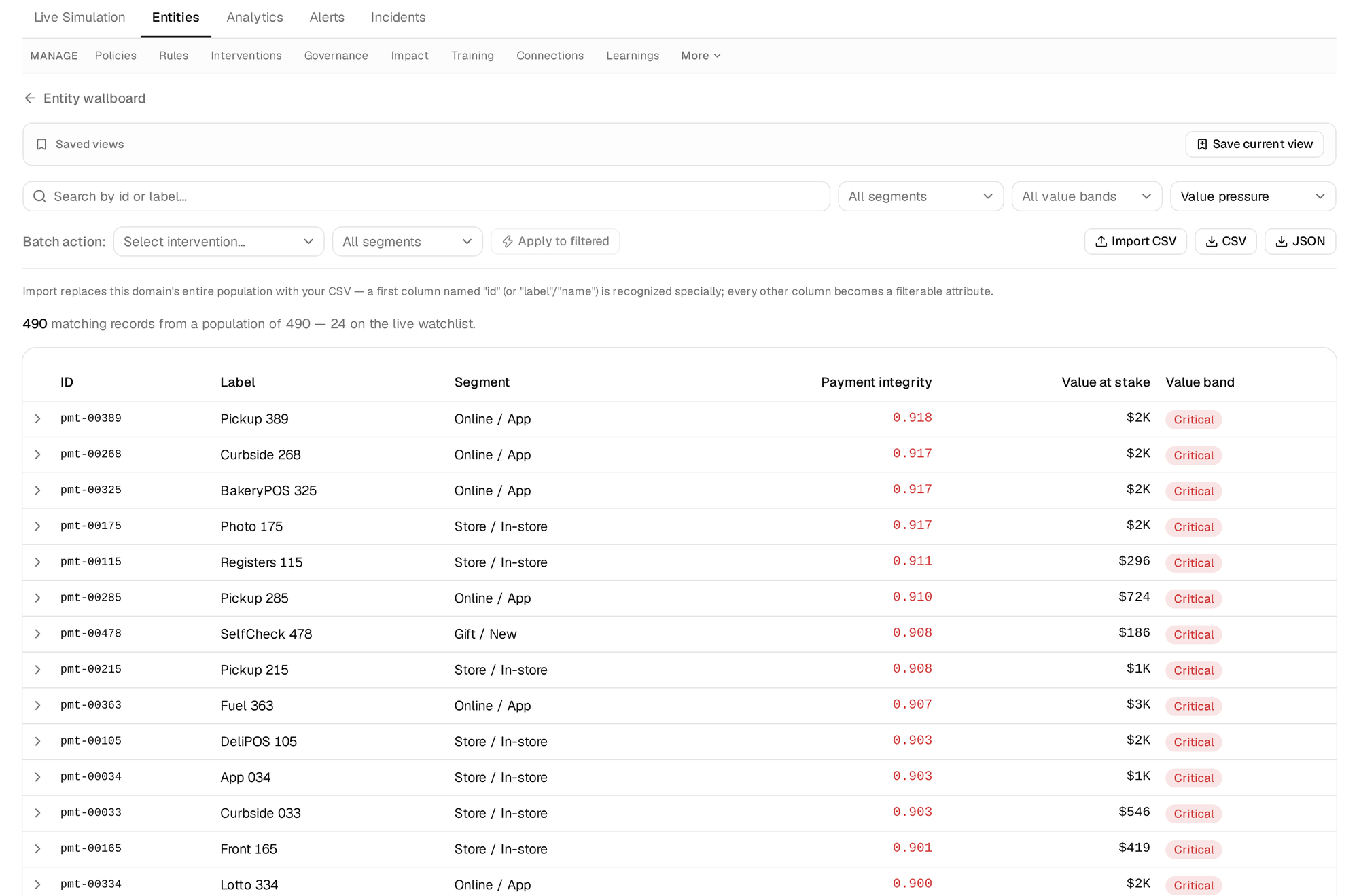
Every store, line, lane or case gets a live position and a direction. The ones that need you are ranked by money at stake, with the cost of acting and of waiting beside each, so the day starts with the right list.
In plain termsA ranked list of what needs attention, with the price of acting and of waiting.
At a glance
A ranked list
Ordered by money at stake, so the top of the queue is usually right.
A direction for each item
Not only the current reading: where it is heading and how fast.
Try it first
Run a decision forward on the live model before you commit to it.
Beside your systems
Read-mostly, so nothing about your operation has to change to start.
The questions you start the day with
- Which store, line or lane needs me first, and why?
- How long do I have before it costs more to fix?
- What does acting cost, against what waiting costs?
- Will my team work from this list, or from the one they already trust?
The list your team works top-down
Rules produce volume, and the one that matters looks like all the rest. A queue ranked by money at stake, with notification limits that ration the volume, gives a team one list and a reason for its order.
What it looks like across a hundred stores
One compromised till is a local problem. The same pattern across a dozen stores is something else, and you only see it when state is tracked across the region. See retail and commerce and the other eleven industries.
One payment pattern across stores · illustrative
- Day 1: One till declines more cardsLooks local, and under every rule's limit
- Day 2: Three stores, one tender typeA shared driver shows in store state
- Day 3: Flagged as one patternRanked by money at stake
- Day 4: Action priced and appliedCost to act beside cost to wait
- Week 3: Finance finds itThe usual way: at reconciliation, after the money has moved
- Phase: Visible in store statefrom One till declines more cards to Flagged as one pattern
- Events are shown in order, not to scale.
Concerns an operations leader is likely to raise
| The concern | The answer |
|---|---|
| My team is already drowning in alerts. | The point is fewer, ordered ones: ranked by money at stake, with limits on how many reach a person. |
| I can’t change systems to try this. | It reads events and reference data and writes nothing by default. Any write is a named, audited action. |
| It will override my people’s judgment. | By default it recommends and a person decides. Where you grant automation it is per action class, with limits and a stop when evidence conflicts. |
Bring a decision, leave with a list
Bring:
- The decision you wish you could make earlier
- A month of events from the area behind it, if you have them
You leave with a forward position for the items behind that decision, and the queue re-ordered by value at stake.
Start with the decision you make too late
Bring one domain and a month of events. We will show where it was heading before it showed.