Decisions you can inspect, explain and reproduce.
Every conclusion in AnantState comes with the facts behind it, how much the learned part changed the answer, and who approved the action. Re-run it on the same inputs and you get the same result, so a reviewer can check the work instead of taking it on trust.
In plain termsClick any recommendation and see what it rests on: the events, the forecast, the policy checks and the person who signed.
At a glance
A chain back to the facts
Each conclusion lists the evidence that supports it and the evidence that cuts against it.
The learned part is measured
You see how much it moved each answer, and you set how far it is trusted.
Same inputs, same answer
Any decision can be re-run and compared with the original.
Every action has an owner
Recommendations, approvals and overrides all carry a name and a reason.
What a decision record shows
An example from the OgMart payments domain. Every recommendation in the product has one of these behind it.
| Field | Example |
|---|---|
| What changed | Card-not-present declines at one store group rose for three days, well outside their usual weekly pattern |
| Forecast | If nothing changes, the shortfall keeps growing over the declared horizon; the record shows the range, not a single figure |
| Evidence for | Decline rate, chargeback feed, terminal firmware version |
| Evidence against | Network status was normal. The two sources disagree, so the case is marked contested |
| Learned contribution | The learned part moved the forecast by a small, stated amount; the rest came from the declared baseline |
| Policy checks | Action within spending limit; requires approval above the configured value |
| Recommended action | Review the terminal batch, with its cost and the cost of waiting beside it |
| Approved by | Named user and time, with any override reason |
The same record can be pulled up months later to answer “why did we do that?” without anyone reconstructing it from memory.
One recommendation, and everything behind it
- What changedLeads to: Recommended action
- Forecast: A range, not one figureLeads to: Recommended action
- Evidence forLeads to: Recommended action
- Evidence against: Disagreement is keptLeads to: Recommended action
- Policy checks: Limits and approval rulesLeads to: Recommended action
- Recommended action: With its cost and the cost of waitingLeads to: Approved by
- Approved by: Named user, time, any override
Four properties you can test
“Explainable AI” is often a slide. We treat it as four properties a reviewer can check.
Reproducible does not mean correct
Re-running a decision and getting the same answer proves the computation is repeatable. It does not prove the answer is right. A conclusion can still rest on bad inputs, a wrong assumption or a forecast that misses.
That is why the platform also tests its forecasts against the simple guess that nothing changes, at the distance ahead you choose, and records where it loses. Traceability tells you how a decision was made; the model record tells you how often to trust it. You need both. See the evaluation methodology.
There is a learned component. It is a specialized predictive model that corrects a known behavioral baseline. It is bounded, its influence is visible per dimension, and its error is reported against a baseline you can check.
How this differs from a language model
| Question | AnantState |
|---|---|
| Does it generate text? | No. Conclusions are computed from state, evidence and rules, so there are no prompts and no hallucinated prose. |
| Is there a token meter? | No. Inference cost does not depend on how much you ask. |
| Does phrasing change the answer? | No. The domain definition and the evidence determine it. |
| Does the same input give the same answer? | Yes. The same state and evidence produce the same conclusion. |
| Does it depend on a third-party model? | No. Nothing retires or reprices underneath you. |
Your rules, your thresholds, your actions, your authority
Most platforms ship an inference engine and ask you to accept its judgment. Here, the business defines the reasoning.
| The business defines | Meaning |
|---|---|
| The ontology | The vocabulary of entities, state dimensions and relationships |
| The dynamics | How state moves, in the business’s own terms |
| Thresholds and bands | What counts as elevated, for whom, and where the lines sit |
| The interventions | What actions exist, what they cost, what they may affect |
| The decision horizon | How far ahead the platform must be right |
| The action framework | Which actions need a human and which may be automatic |
| The escalation policy | What happens when evidence conflicts or confidence is low |
The platform contributes the forward position, the evidence and the discipline. The authority stays with you. Where you want automation you grant it explicitly, per action class, with limits, never as a global switch. See next best action.
What to ask any vendor that says “AI”
Six questions that separate the categories
- Is any of this generated text, or is it all derived? If generated, what stops it inventing something?
- Show me the chain from a conclusion back to its inputs.
- Will the same inputs produce the same conclusion tomorrow?
- How much of the answer came from the learned component, and how do I change that weighting?
- What happens to my reasoning when the vendor retires a model version?
- Where is the token meter? If there is one, you are buying inference.
We will answer all six on your data.
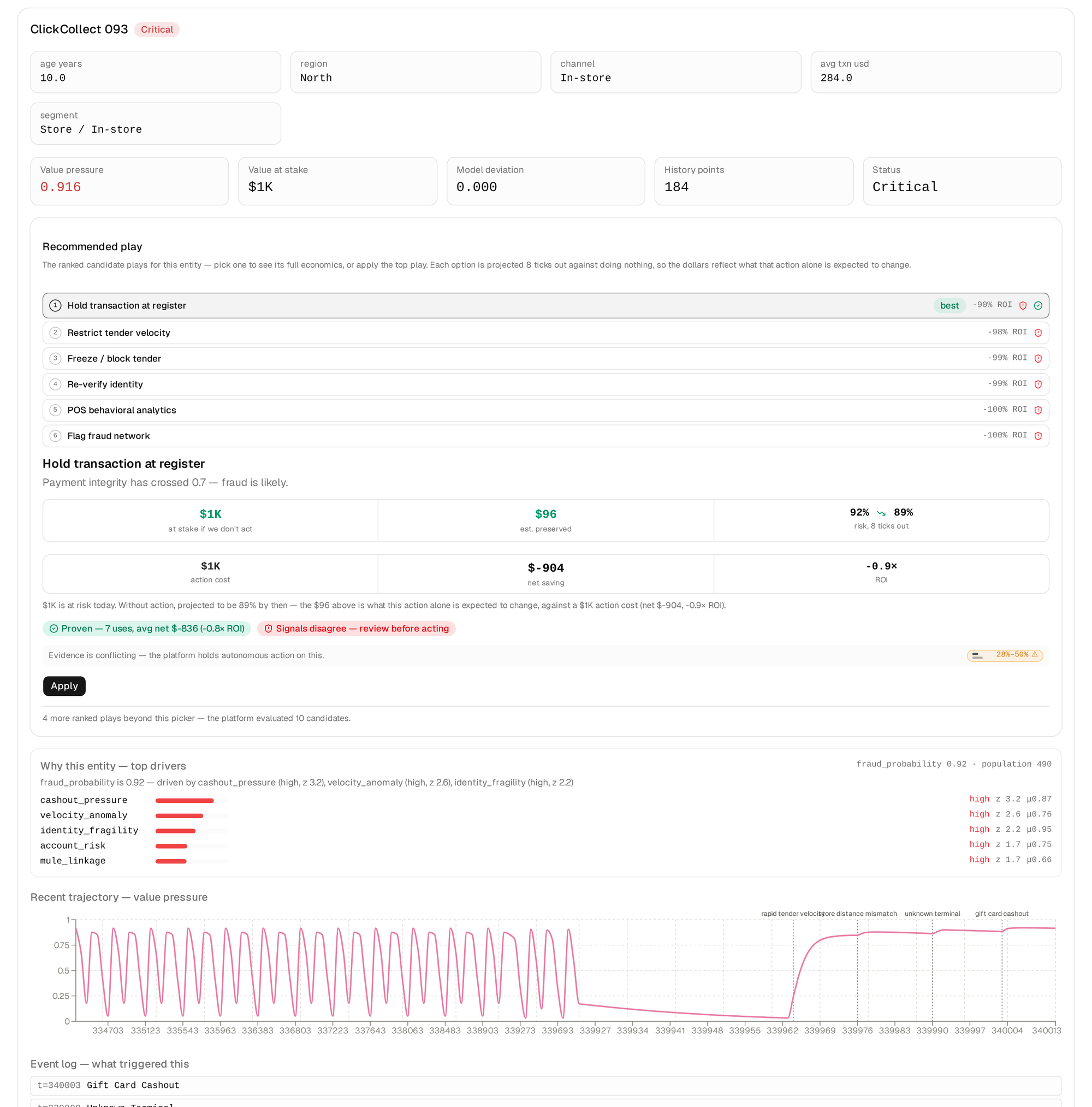
Why this entity: the drivers, in the open
Each conclusion shows the drivers behind it and the events that triggered it. Re-run it and the same drivers appear.
Ask the six questions of us first
A technical session is the fastest way to see a derived conclusion traced back to its inputs, on a domain you recognize.