An account is a relationship with a history.
AnantState tracks where each account, merchant or case is heading, with the evidence and the cost of acting attached, so a decision reads as a reviewable record.
In plain termsSee how each account is moving, beyond the flag it has today.
One case, start to finish
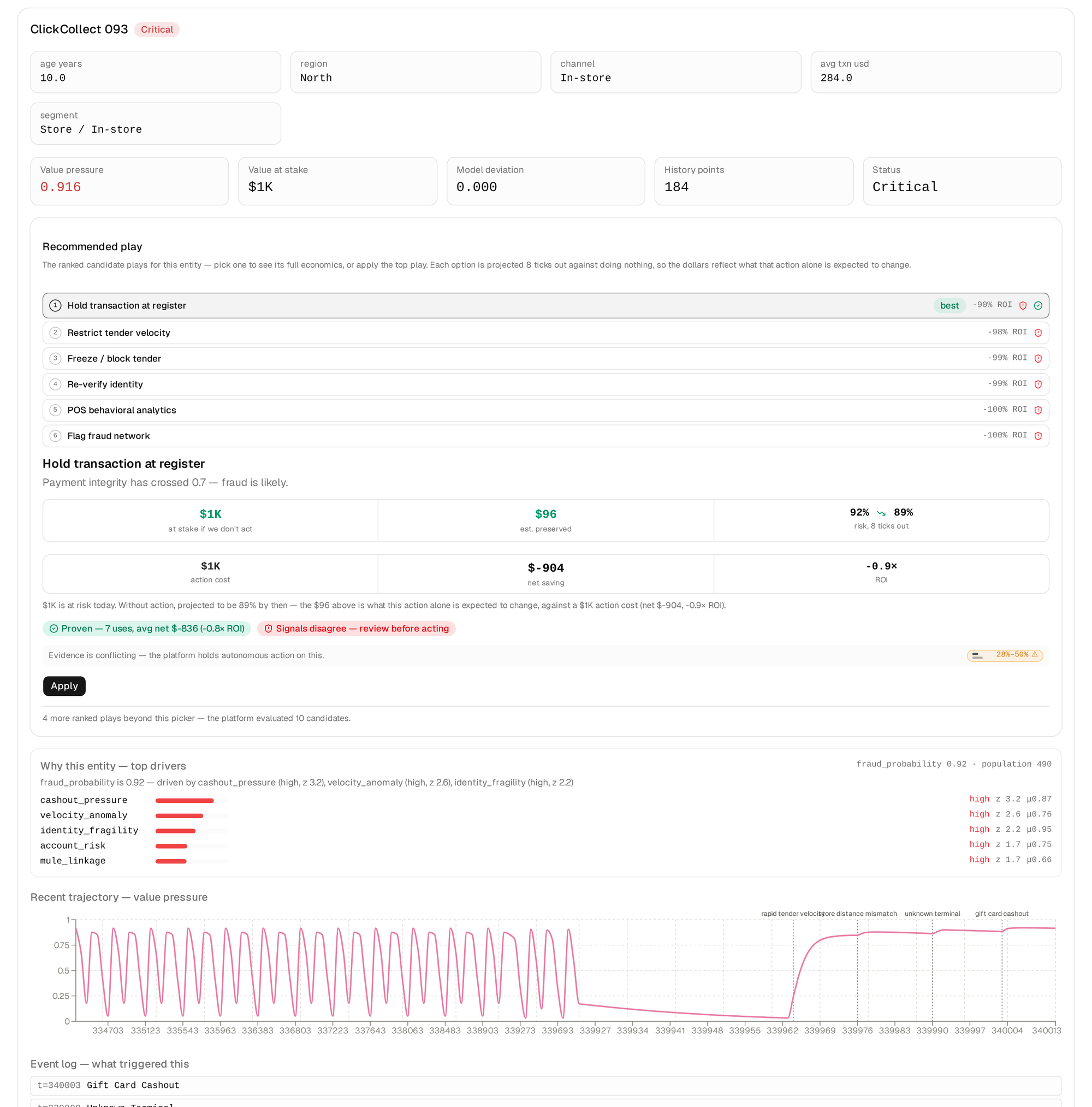
An entity here is usually a relationship with a history: an account, a member, a merchant, a card, a device, a dispute. The case below is ranked with its evidence, and where sources disagree it is marked contentious, because that is the case an experienced analyst should see and the one a single score hides.
One case, start to finish
- 1. Account activity to AnantState: Behavior breaks from its history
- 2. AnantState to An analyst: A ranked case, sources in conflict
- 3. An analyst to AnantState: Approves a priced hold
- 4. AnantState to Audit trail: Evidence, decision, actor, timea reply or asynchronous
The false-positive question
Declining a legitimate customer is a real loss that rarely appears as a line item, so the rule that causes it is rarely challenged. Step-up authentication, a hold and a manual review each carry a cost here, which turns the false-positive trade-off into an explicit, reviewable decision rather than a rule someone set two years ago.
- Alert volume is managed by headcount when it could be managed by value: the queue is ranked by money at stake.
- Model risk review runs behind the pattern, so the validation function gets a record it can read, including the horizons where the model does not beat the simple guess.
What moves in an account
| State | Baseline drivers | Unexpected drivers |
|---|---|---|
| Fraud posture | Seasonality, channel mix, product behavior | New attack patterns, account takeover, mule activity |
| Credit posture | Tenor, payment cycle, utilization | Employment change, hidden leverage, behavior break |
| Dispute pressure | Volume, product, partner | Merchant failure, systemic event |
| Investigation load | Case arrival rate | A single organized pattern creating correlated cases |
A worked example
Five thousand open cases, and a team that can review one in seven.
Round, illustrative figures for open cases: they show the arithmetic, leave out the subscription, and are for you to change in the calculator.
| Input | Value | What it stands for |
|---|---|---|
| Open cases in scope | 5,000 | Everything the team is responsible for |
| Value at stake per one | $1,800 | Loss on one case if nothing is done |
| Cost of the action per one | $45 | A manual review or step-up check |
| Share acted on | 15% | The cases at the top of the queue: 750 of 5,000 |
| Modeled, USD | Pessimistic | Expected | Optimistic |
|---|---|---|---|
| Share of value at stake avoided | 5% | 15% | 30% |
| Cost to act, in total | $33,750 | $33,750 | $33,750 |
| Avoided loss | $67,500 | $202,500 | $405,000 |
| Net position | $33,750 | $168,750 | $371,250 |
Break-even is 2.5%: each action costs $45 against $1,800 at stake, so it has to avoid that share of the loss to pay for itself.
Regulatory notes
- Explainability is a regulatory expectation in most jurisdictions, and an engineering property here: every conclusion carries its evidence.
- Model governance maps to model risk management expectations: documented purpose, measured performance against a defined baseline, a recorded promotion decision, and drift monitoring.
- Data residency and tenancy are deployment questions. See governance and control.
What exists today
Financial services exists as a catalog template: loadable, and the starting point for an ontology workshop.
Price the false positive
Bring a rule whose false-positive cost nobody has measured. We will price it against the cost of the loss it prevents.